

- For US Eye Care
Professionals - Important Safety
Information - Full Prescribing
Information - Patient
Information - Medical
Information - Visit
Patient Site - REQUEST A REP
- SIGN UP
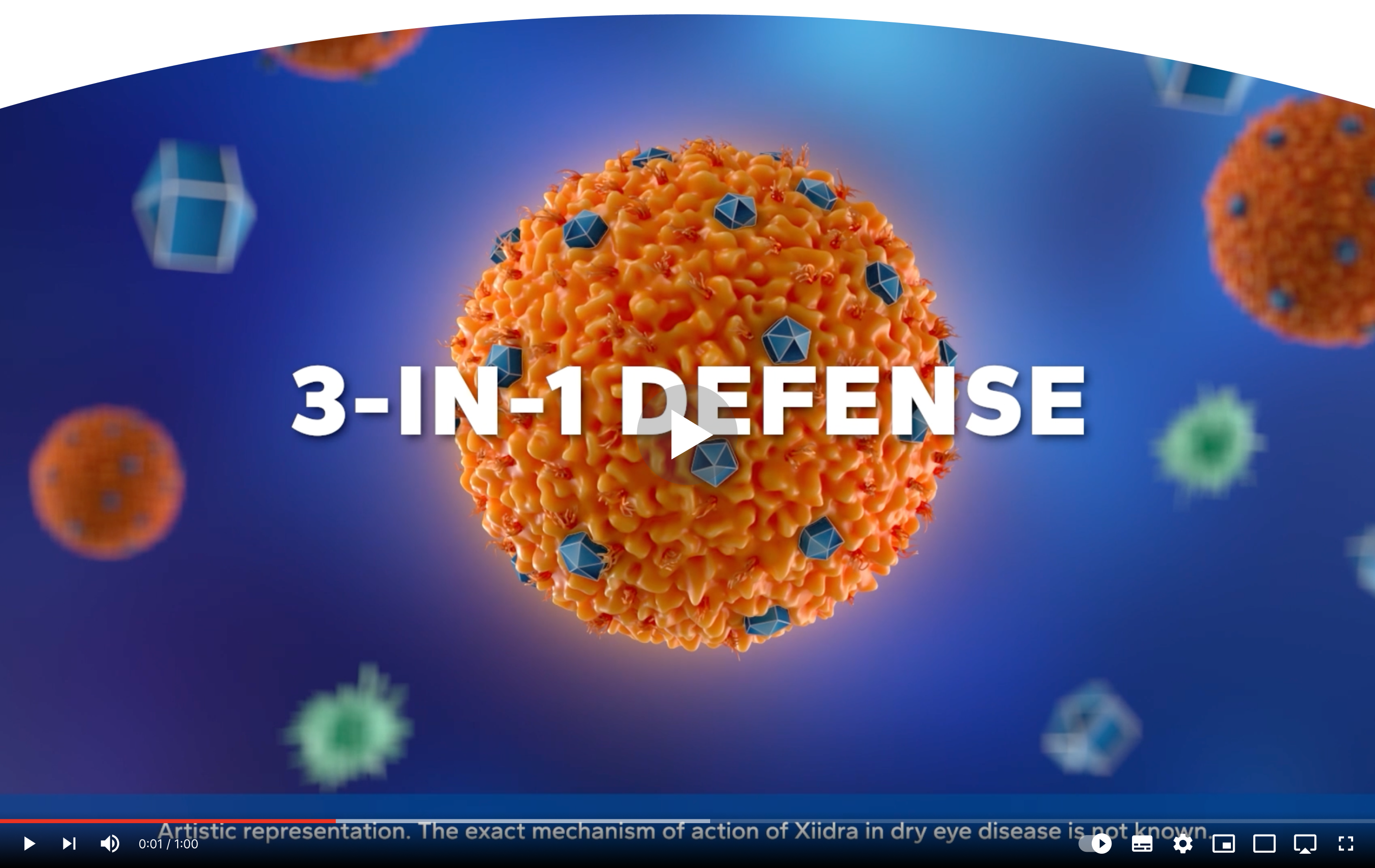

SEE THE DIFFERENCE
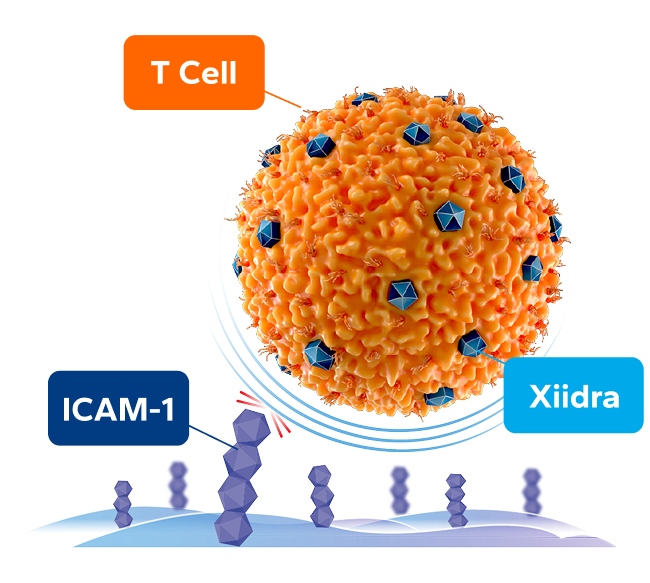
By targeting the ICAM-1/LFA-1 interaction, Xiidra provides a 3-IN-1 DEFENSE against dry eye inflammation1,5
BLOCKS T-cell activation at multiple sites1,5
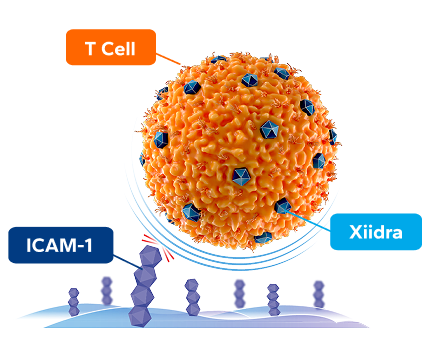
INHIBITS T-cell migration to the ocular surface1,5

REDUCES proinflammatory cytokines1,5
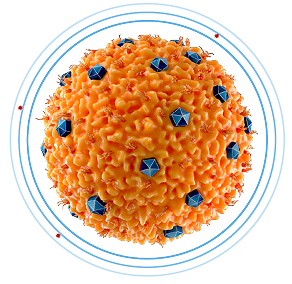

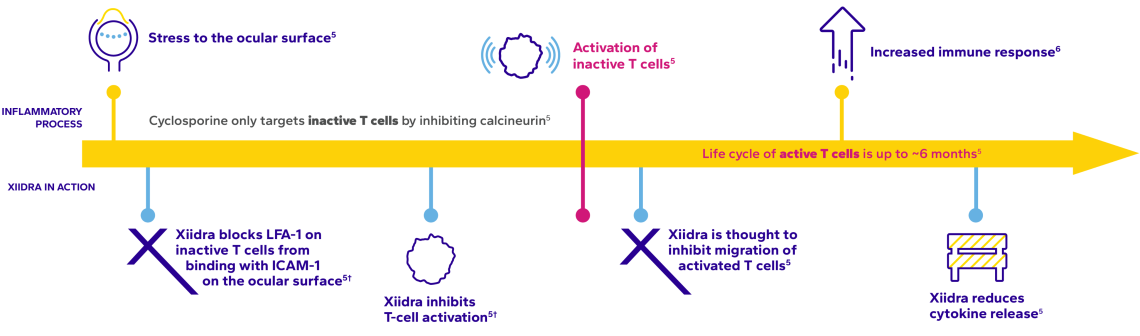
AN UNDERLYING cause: Inflammation
Up to 65% of patients with dry eye may have clinically significant ocular surface inflammation6
EARLY RELIEF AND LONG-TERM CONTROL
Xiidra can start to deliver symptom relief as early as 2 weeks1‡
ICAM-1, intercellular adhesion molecule 1; LFA-1, lymphocyte function-associated antigen 1.
The exact mechanisms of action of Xiidra and cyclosporine in dry eye disease are not known.
*There are no head-to-head studies of Xiidra and cyclosporine.
†Based on in vitro data.1
‡Xiidra significantly reduced symptoms of eye dryness at 2 weeks in 2 of 3 phase 3 studies, with improvements observed at 6 and 12 weeks in all 3 studies.1
Indication and important safety information


Indication
Xiidra® (lifitegrast ophthalmic solution) 5% is indicated for the treatment of signs and symptoms of dry eye disease (DED).
Important Safety Information
- Xiidra is contraindicated in patients with known hypersensitivity to lifitegrast or to any of the other ingredients.
- In clinical trials, the most common adverse reactions reported in 5-25% of patients were instillation site irritation, dysgeusia and reduced visual acuity. Other adverse reactions reported in 1% to 5% of the patients were blurred vision, conjunctival hyperemia, eye irritation, headache, increased lacrimation, eye discharge, eye discomfort, eye pruritus and sinusitis.
- To avoid the potential for eye injury or contamination of the solution, patients should not touch the tip of the single-use container to their eye or to any surface.
- Contact lenses should be removed prior to the administration of Xiidra and may be reinserted 15 minutes following administration.
- Safety and efficacy in pediatric patients below the age of 17 years have not been established.
You are encouraged to report negative side effects of prescription drugs to the FDA. Visit www.fda.gov/medwatch or call 1-800-FDA-1088.
You are encouraged to report negative side effects of prescription drugs to the FDA. Visit www.fda.gov/medwatch or call 1-800-FDA-1088.
Click here for full Prescribing Information for Xiidra.
References
- Xiidra. Prescribing Information. Bausch & Lomb Inc.
- Restasis. Prescribing information. Allergan; 2017.
- Vevye. Prescribing information. Harrow Eye, LLC; 2023.
- Cequa. Prescribing information. Sun Pharmaceutical Industries Limited; 2022.
- Donnenfeld ED, Perry HD, Nattis AS, Rosenberg ED. Lifitegrast for the treatment of dry eye disease in adults. Expert Opin Pharmacother. 2017;18(14):1517-1524. doi:10.1080/14656566.2017.1372748
- Data on file. Bausch & Lomb Inc.
Indication and important safety information


Indication
Xiidra® (lifitegrast ophthalmic solution) 5% is indicated for the treatment of signs and symptoms of dry eye disease (DED).
Important Safety Information
- Xiidra is contraindicated in patients with known hypersensitivity to lifitegrast or to any of the other ingredients.
- In clinical trials, the most common adverse reactions reported in 5-25% of patients were instillation site irritation, dysgeusia and reduced